


What is Esports Betting? A Beginner’s Guide on How it Works

Esports betting is the wagering on the outcomes of competitive video game matches and tournaments, players and teams. Just as fans bet on sports like football, tennis or F1, esports fans can bet on Counter-Strike 2, League of Legends, Dota 2, and Valorant esports, backing a team to win a match, predicting how a tournament will unfold, or even wagering on specific objectives within a game.
In this guide, I’ll explain how esports betting works, from understanding odds to the main types of bets, and cover what to keep in mind before placing a wager, including how to bet safely and responsibly.
What is esports?
If you already know about esports, you can skip this section to go straight into how esports betting works.
- Esports is organized, competitive video gaming, where players or teams play against each other in structured matches and tournaments for prize money, rankings and titles.
- It’s the video game equivalent of traditional sports leagues with professional players, coaches, teams with sponsors, regular seasons, playoffs, and championship events.
- Esports competitions range from small online tournaments to huge LAN events in arenas.
- The biggest championships draw millions of viewers, mostly through streaming platforms like Twitch, Kick and YouTube.
- Like their sports peers, esports professional players train many hours a day, often live together in team houses, and can earn substantial salaries, sponsorships, and prize winnings, with some tournaments offering prize pools in the millions of dollars.
- The esports games themselves span many genres, including multiplayer battle arenas like League of Legends and Dota 2, tactical shooters like Counter-Strike 2 and Valorant, fighting games like Street Fighter and Tekken, sports games like EA Sports FC, and battle royales like Fortnite and PUBG. The table below gives you an overview of each genre.
| Genre | What it involves |
|---|---|
| MOBA | Two teams of five battle to destroy the enemy base on a map |
| Tactical shooter | Teams alternate attack and defense over rounds, often planting or defusing a bomb |
| Hero shooter | Team-based shooting with characters that have unique abilities |
| Battle royale | Many players or teams fight to be the last one standing |
| Sports simulation | Virtual versions of real sports, usually played one-on-one |
| Real-time strategy | Players build economies and armies to defeat an opponent |
| Fighting game | One-on-one combat across a series of rounds |
| Digital card game | Strategic card battles between two players |
| Vehicular sports | Teams play football using rocket-powered cars or compete to win a race |
How esports betting works
Esports betting works much like betting on traditional sports – you place a wager on the outcome of a map, match, player or other event through a sportsbook, and if your prediction is right, you win money based on the odds.
Odds
The bookmaker sets odds that reflect how likely each outcome is and determine your payout. With decimal odds (most commonly used in Europe), a €10 bet at 2.50 returns €25 if it wins, meaning €15 profit plus your stake back.
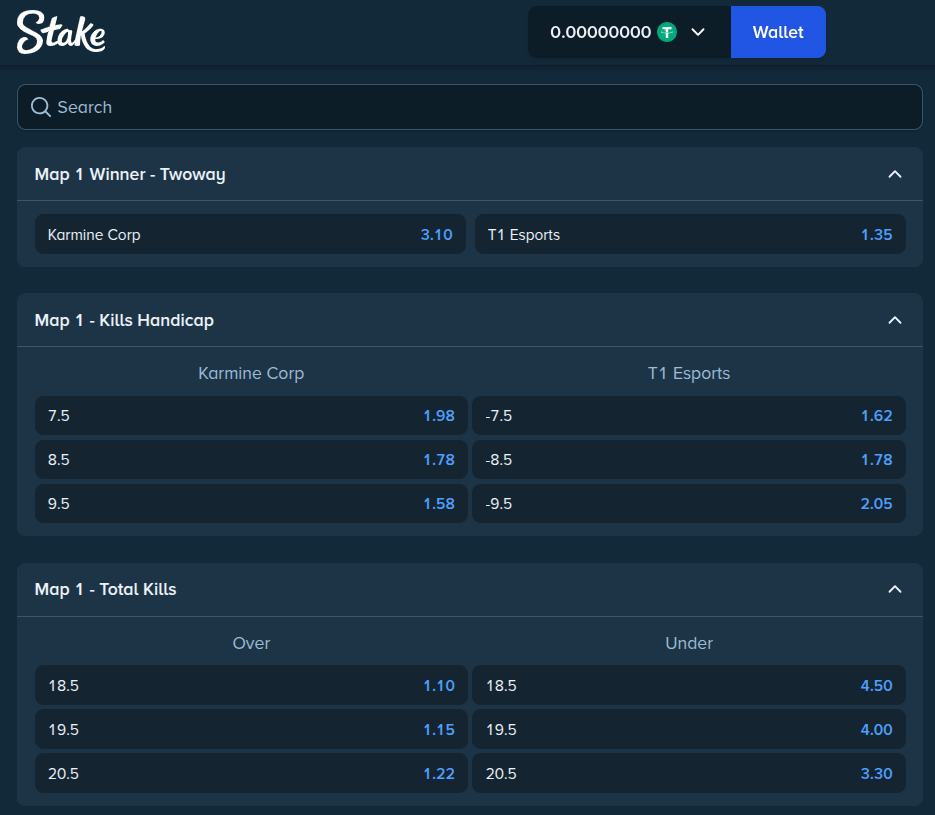
Editor’s note: Bookmakers let you view odds in your preferred format
Virtually all of the bookmakers we use have let us switch between odds formats based on our preferences. So you can choose whichever format you find easiest to read, especially if you’re betting on the action live.
Favorites have lower odds and smaller payouts, whilst underdogs have higher odds and bigger payouts. Bookmakers also build in a margin, so the odds are slightly less favorable than the “true” probability, which is how they profit over time.
Bets
Like in sports, the simplest esports bet is the match winner bet on which team wins. Map or match handicap bets give one side a virtual advantage, for example betting that a favorite wins a best-of-three series 2-0.
Over/under bets are on totals like the number of maps played, kills or rounds. Prop bets cover specific events within a match, such as which team gets “first blood” or destroys the first tower. Outright or futures bets are on who will win an entire tournament. Live (in-play) betting lets you bet while a match is underway, with odds shifting in real time. I’ll go into more detail on markets below.
Coverage
Most major licensed sportsbooks now include an esports section covering the big titles like Counter-Strike 2, League of Legends, Dota 2, Valorant and Mobile Legends, and smaller titles like Fortnite, Call of Duty, Rainbow Six, PUBG and PUBGM, NBA 2k and others.
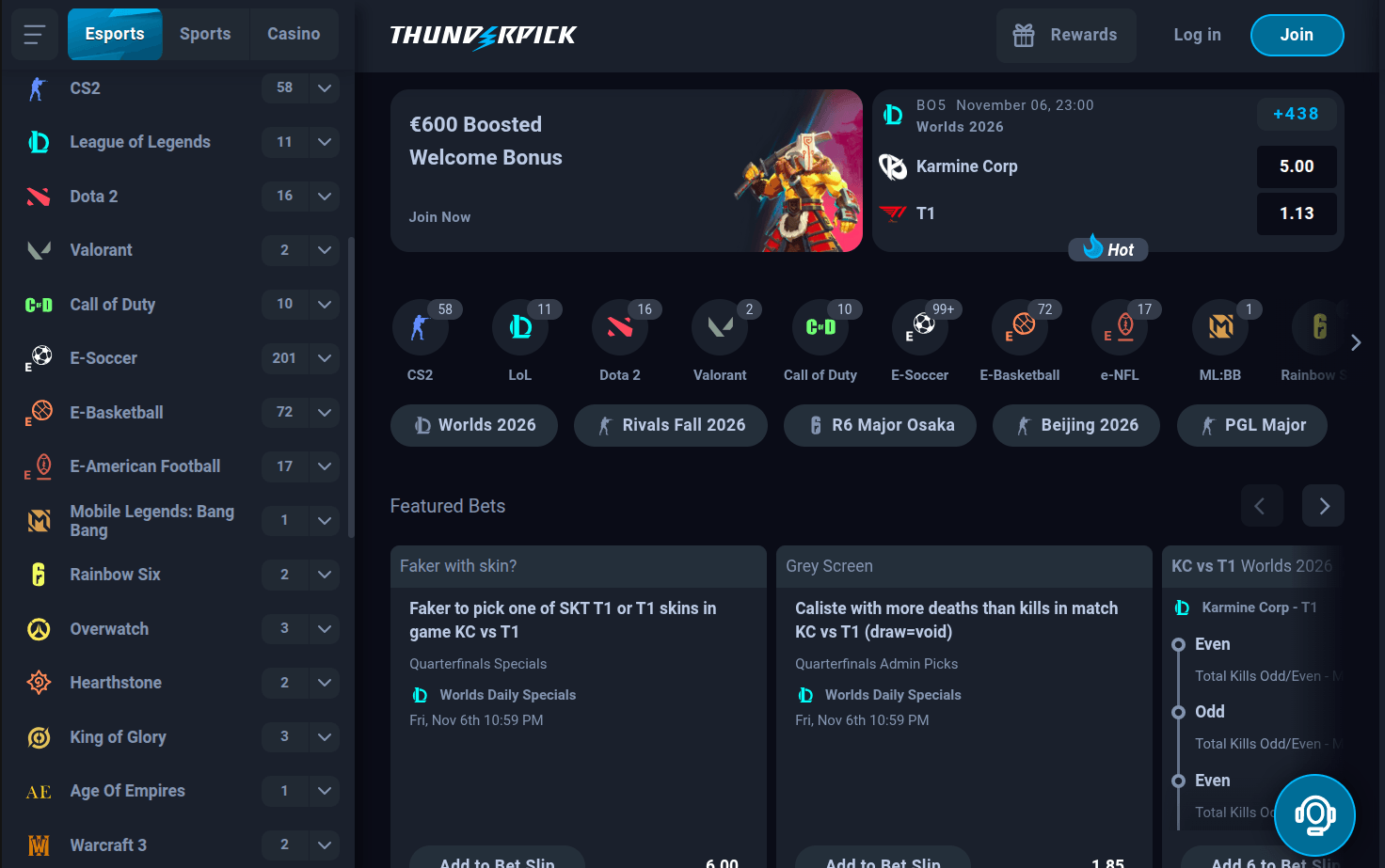
The breadth of esports coverage at bookmakers can vary. Esports-focused betting sites like Thunderpick would typically offer an expansive range and depth of markets.
Editor’s note: What makes an esport “large” or “small” for betting?
When we describe an esport as large or small, we’re referring to how much betting activity it attracts and how much coverage bookmakers give it, not how many people play or watch it. The two don’t always line up. Fortnite is a good example. It’s one of the most popular games in the world, with a huge player base and a massive online following, yet it’s a small title in esports betting.
Bookmakers offer few Fortnite markets, and those they do offer attract relatively little money. By contrast, Counter-Strike 2 has a smaller player base than Fortnite but is the largest esport for betting, thanks to its head-to-head format, mostly adult audience, packed tournament calendar, skins trading scene and long-established competitive scene.
The main categories of esports bets
In this article I am going to focus on the four main categories you’ll find at esports betting sites. These bets differ mainly in when you place the bet and what you’re betting on.
Pre-match betting
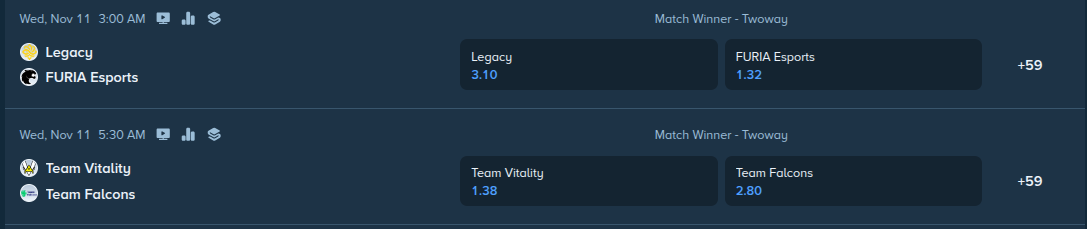
Pre-match bets are placed before a match starts on markets like the winner, map handicap, or total maps played. The odds are fixed when you bet, based on factors like team form, head-to-head records, and roster news.
Live betting
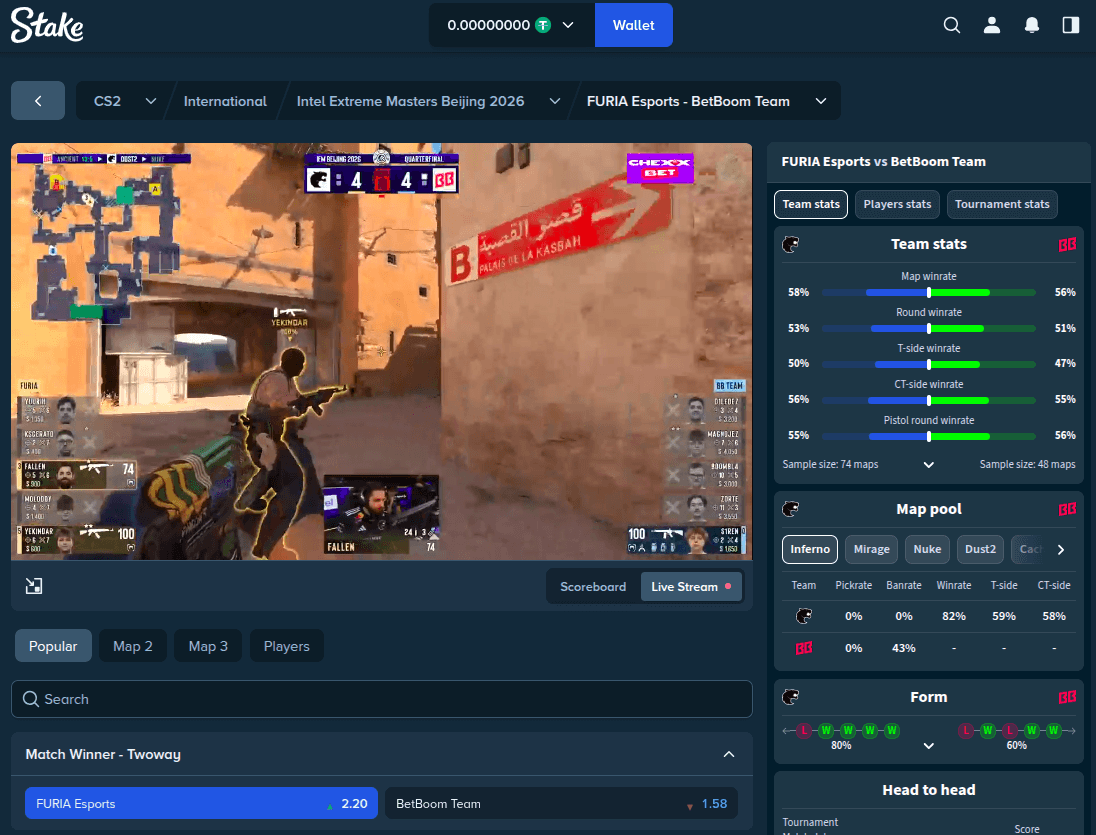
Live (in-play) betting happens while the match is underway, with odds updating constantly to reflect what’s happening. In esports, that can mean betting on the winner of the next map after the first one ends, or on which team wins the next round in Valorant. It lets you react to how a match is unfolding, but it’s also the fastest-paced form of betting, which makes impulsive decisions and chasing losses much easier. Odds can also shift or get suspended in seconds, and stream delays mean the bookmaker may have information slightly ahead of what you’re watching.
Outright betting
Outright (futures) betting is a wager on an outcome far in the future, usually who will win an entire tournament, league, or season. Example: betting before the group stage on which team will win League of Legends Worlds. Odds are often generous because so much can change, but your money is tied up for weeks or months, and upsets along the way can sink a pick long before the final.
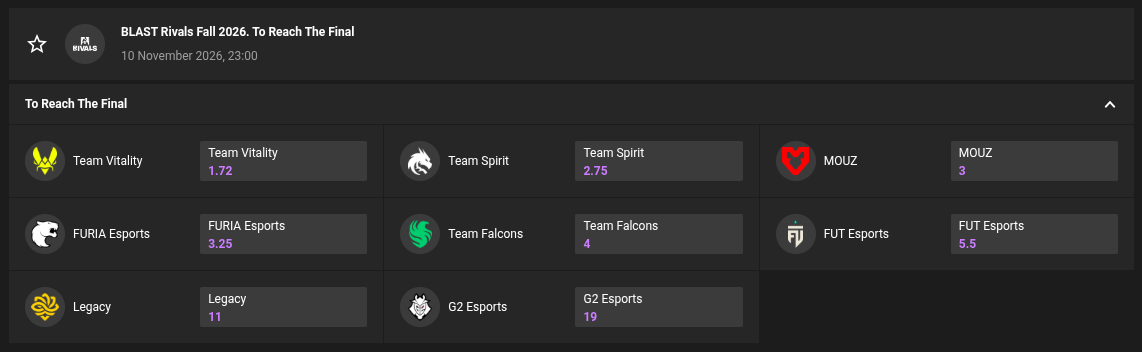
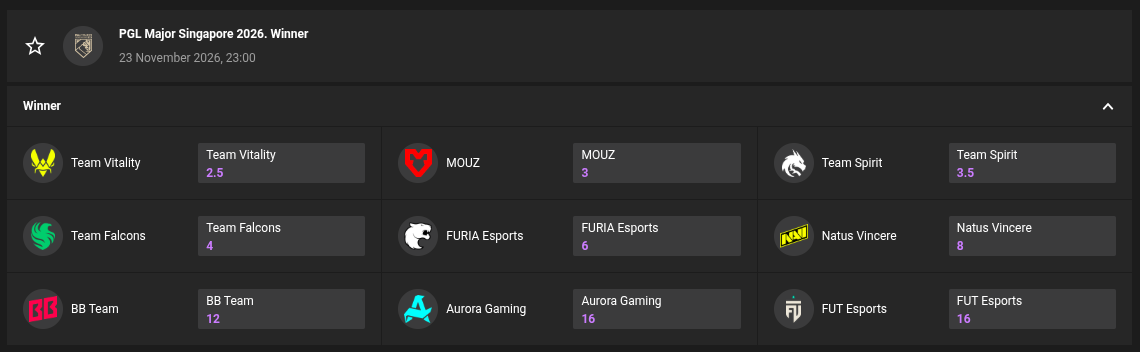
Counter-Strike outright bets at GG.Bet include teams to reach the final (pictured above), team to win the event (pictured below), group qualification, etc.
Prop betting
Prop (proposition) betting focuses on specific events within a match rather than the final result. Examples include which team gets first blood or destroys the first tower in League of Legends, whether a particular player gets the most kills, or whether a Counter-Strike map goes to overtime. They’re appealing to fans who know the game deeply, but outcomes often hinge on small, random moments. Props can be placed pre-match, live or as outrights (see blow).
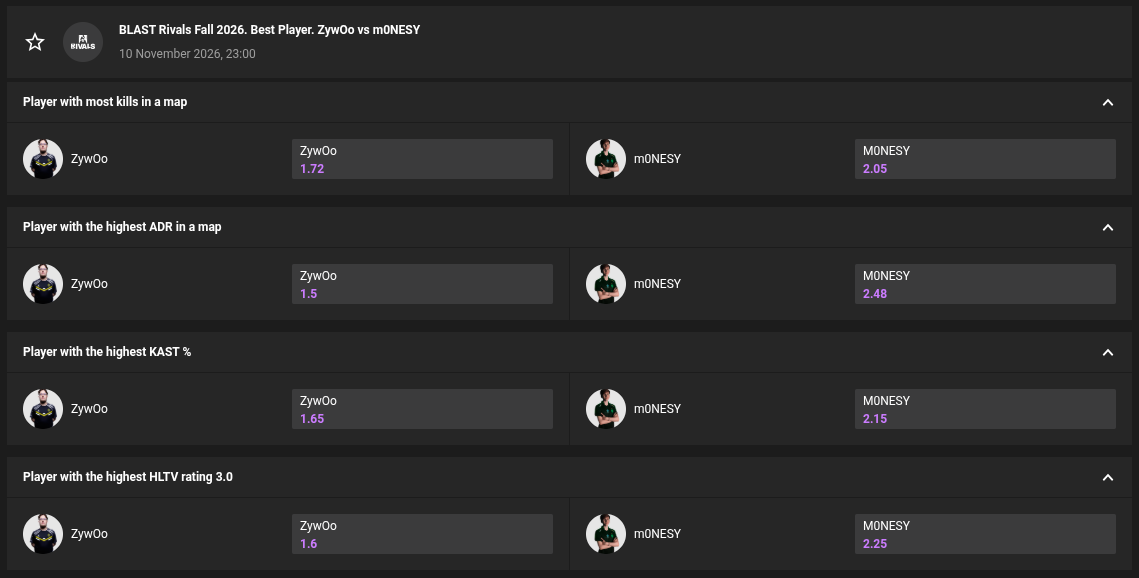
Examples of outright player props at GG.Bet.
The legality of esports betting
In most countries esports is handled under the same laws as traditional sports betting. Broadly, countries fall into four groups.
- Regulated, licensed markets – In these countries, betting sites can legally offer betting if they hold a license from the national regulator. Bettors are expected to use licensed sites, and unlicensed operators are often blocked.
- State-monopoly markets – Some countries allow sports betting only through a government-run or government-licensed monopoly, which may or may not include esports. South Korea is a striking case given how central it is to esports: the state-run Sports Toto is the only legal way to bet on sports, and it limits how much people can wager, and esports betting currently isn’t permitted.
Interesting development: In late 2026, the government of South Korea announced its plans to add esports to Sports Toto, the only legal sportsbook, by 2028. That same year, the Korean National Police Agency appointed the esports icon Faker to help spread awareness of the difference between video gaming and gambling.
- Countries that prohibit betting – Sports betting (and therefore esports betting) is banned outright, apart from state lotteries in some cases. China prohibits gambling on the mainland outside its state lotteries, and most Gulf and many other Muslim-majority countries ban gambling for religious and legal reasons. India recently moved firmly into this category for online betting, blocking hundreds of betting sites and apps.
- Gray markets – A gray market exists where betting with offshore operators isn’t clearly legal or clearly illegal. Typically, the country’s gambling laws predate online betting, or they prohibit local operators without explicitly criminalizing residents who bet with foreign sites, and enforcement is weak. Bettors in these countries often use sites licensed in places like Malta, Curaçao or Anjouan. The risk for bettors is that if something goes wrong, such as an operator refusing to pay out, there’s little or no legal recourse in the country in which a player resides. Consumer protections like deposit limits and self-exclusion may be weak or absent.
The bottom line is that you should always check on the legal status of gambling, sports and esports betting in your country before deciding to partake in the activity.
Esports betting in the US
In the US, each state decides on the legal status of sports betting for itself. Many have never addressed esports directly.
Until 2018, a federal law called the Professional and Amateur Sports Protection Act (PASPA) effectively confined full sports betting to Nevada. When the Supreme Court struck it down, states were free to legalize sports betting, but the ruling said nothing specific about esports.
As a result, each state must decide whether esports betting is available to its residents. Sports betting has spread quickly since then. Gambling commissions typically publish a catalog of approved events or leagues that state-licensed bookmakers can offer markets on.
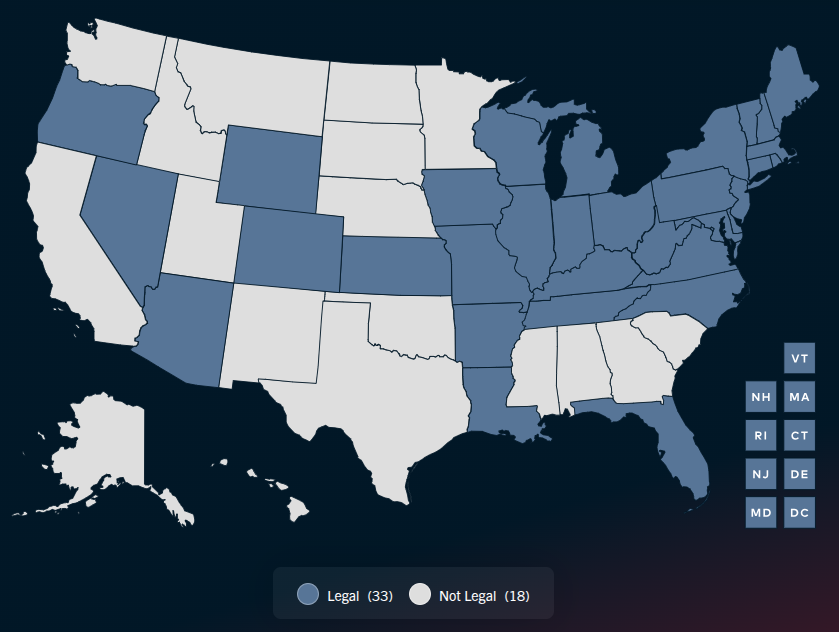
States with legal online sports betting / American Gaming Association
According to the American Gaming Association, legal online sports betting is available in 33 states. States that have legalised esports betting typically have their gambling commissions list the esports and events that licensed bookmakers in the state are allowed to offer markets on.
How to get started with esports betting
The process is much the same on any licensed esports betting site.
- You create an account and verify your identity.
- You make a deposit.
- You browse the esports section.
- You select an esports market to bet on.
- Your selection is added to your bet slip
- You enter your stake and see your potential return before confirming.
- Once confirmed, the bet is locked in at the odds shown.
- When the match ends, the bet is settled: if you were right with your prediction, your winnings are added to your balance; if not, your stake is lost.
Alternatives to esports betting
We’ve established that esports betting will be available depending on the country, and its stance towards it. Again, depending on country, there could be alternatives to esports betting for you to try out, including the following:
Fantasy esports
Like fantasy football, you draft a roster of real pro players and score points based on their performances. Some leagues and fan sites run free seasonal fantasy games, and some feature prizes.
Prediction markets
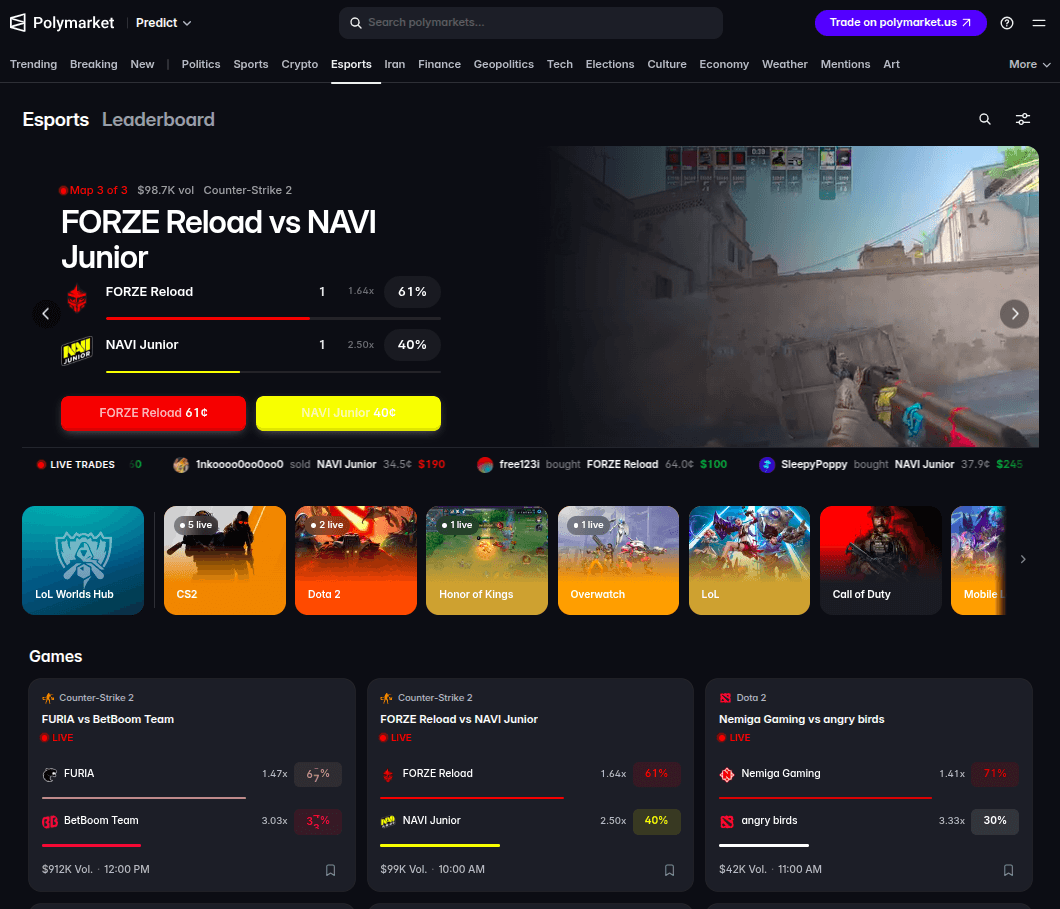
Platforms like Polymarket or Kalshi list esports outcomes as tradable contracts. The legal status of prediction markets varies a lot by country, and some aren’t permitted at all.
Skin betting
This involves wagering in-game items, but it’s largely unregulated, has had serious problems with scams and underage gambling, and is risky in a way that licensed betting isn’t.
Esports integrity and betting
Esports integrity is about making sure competitive matches are fair and that their outcomes reflect genuine effort and skill. It matters to everyone involved, and it especially matters to betting, because bookmakers can only offer markets, and bettors can only trust them, if results aren’t being manipulated.
Match-fixing is the biggest concern for betting: players deliberately losing a match, a map, or a specific in-game event (like first blood) in exchange for payment or to win their own bets.
Integrity is protected through several layers working together. Codes of conduct and anti-corruption rules bind players and teams through tournament contracts. Betting monitoring flags unusual patterns, such as large bets on an underdog or sudden odds movements, which can signal a fix.
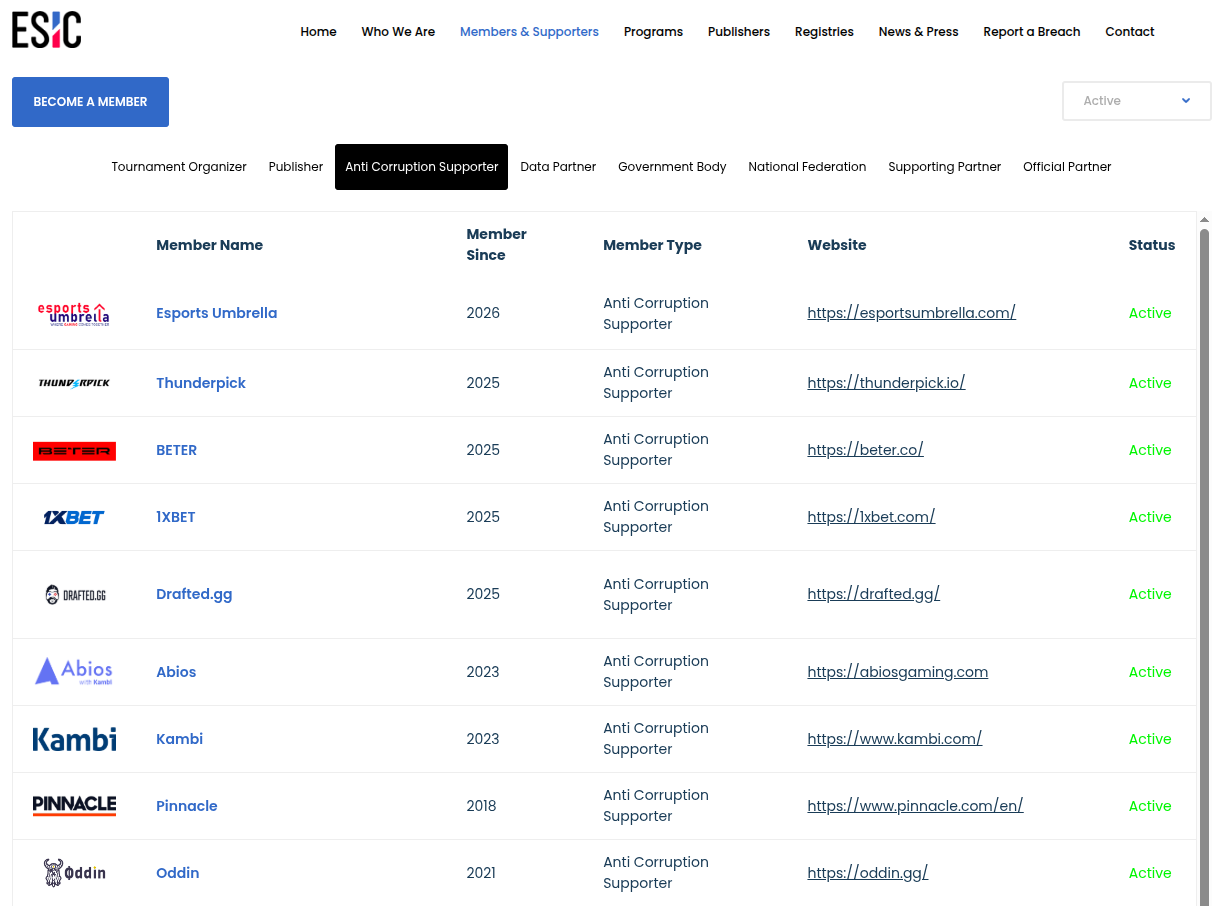
Esports betting stakeholders like bookmakers and infrastructure and data providers are ESIC anti-corruption supports, acting as whistleblowers or watchdogs. (Esports Integrity Commission)
Investigations and sanctions follow up on those alerts, with suspensions and bans for those found guilty. Anti-cheat software, both publishers’ own systems and tournament-side measures, catches illicit programs, while anti-doping testing takes place at major events. Education programs teach players how to recognize and report approaches from fixers.
The Esports Integrity Commission is the closest thing esports has to a central integrity body. It handles competitive integrity issues across esports. It has developed an Anti-Corruption Program, Anti-Doping Program, Player Codes of Conduct, and other best-practice standards.
Game publishers own the games and control their ecosystems, so they set rules, run anti-cheat systems, and license competitions. Riot Games, for example, has partnered with Sportradar, the International Betting Integrity Association and GRID in an effort to protect its competitive gaming ecosystem.
Betting operators and data providers are often the first to spot a fix, since suspicious money shows up on their platforms. Many share data with ESIC providing betting data to help investigate possible match-fixing and fraud.
What this means for bettors
The integrity system works best at the top level, where scrutiny, salaries, and monitoring are highest. Lower-tier matches, obscure leagues, and niche prop markets carry more risk, which is a practical reason for bettors to stick to licensed operators, since those are the ones feeding data into the monitoring system and offering recourse if a market is voided due to suspected manipulation.
Responsible esports betting
Responsible gambling matters with any kind of betting.The core principle is treating betting as entertainment, not a way to make money. In practice, that means:
- Setting a fixed budget you can comfortably afford to lose.
- Never topping up your balance mid-session.
- Setting time limits as well as money limits.
- Never chase losses by betting more to win back what you’ve lost.
Licensed operators offer tools that make gambling control easier, such as deposit limits, loss limits, session reminders, cooling-off periods, and self-exclusion. In many countries, there are also national self-exclusion systems that block access across all licensed sites at once. Using licensed platforms rather than unregulated ones matters precisely because these protections exist there.
Resources




Related Articles
All News
 Mobile Legends

 LoL

 Fortnite
 LoL

 CS2
 LoL
 LoL

 Esports
 Esports
 CS2
No comments yet











 Spain. LaLiga. EA FC 25. (2x4 min)


 Italy. Seria A. EA FC 25. (2x4 min)


 World Cup. EA FC 25. (2x4 min)


 Copa Libertadores. EA FC 25. (2x4 min)


 Champions League. EA FC 25 (2x4 min)



Leave a Comment
Join our community or access your account to post a comment.