


Esports Roster Changes: How They Affect Predictions?


You’ve just placed a bet on Fnatic to win the next event because you’ve seen terrific odds… only to realize they’ve changed 2 starting players who have strong chemistry potential in the long run, but simply won’t click after just 2 weeks on the roster.
Welcome to roster changes, where teams and coaches gamble with their organizations in hopes of creating the perfect combination of individual skills and teamwork potential.
Needless to say, roster changes heavily affect how we predict future matches. New signings end up changing roles, adding new maps to the teams’ pools, and affect in-game calls, tactics, and communication.
So, before you start placing Dota 2, LoL, or CS2 bets on a popular team with a brand-new core, here are some things you should keep in mind.
How can roster changes affect a team
Roster changes are the fastest way to help a struggling team find its pace… but it’s also the fastest way you can ruin a good team that needed just a tiny bit of oomph to create a legacy.
It has happened before; it will happen again.
How come?
It’s simple: every roster change (even a rotation alteration) can greatly affect how a team performs at the highest level. Here are the biggest changes:
In-game leader change
New IGLs change the team’s tactical approach and affect both the match tempo and the in-game communication hierarchy. Even though this might be just a single-person roster change, a different in-game leader usually shifts different responsibilities on existing players, which can affect their performances during the transition.
Core rebuild
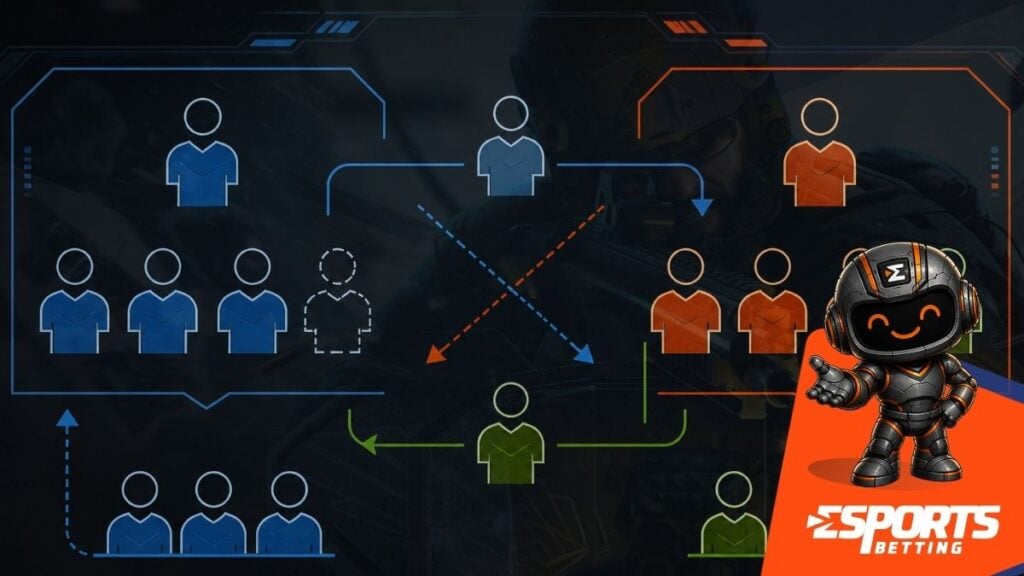
By core rebuild, we’re referring to additions of 3 or more players to the starting team. More often than not, this completely changes how the team performs, no matter the game in question.
The bigger the core rebuild, the more time it will take for the new roster to function as it should. It will take weeks, sometimes even months, for everything to snap into place and for the players to fit snugly in terms of their roles and communication patterns.
Map pool and champion pool differences
A new player, or a set of new players, will greatly affect how the team plays on specific maps and against specific champions. In FPS games like Counter-Strike 2 and Valorant, map pool plays a pivotal role, so coaches will have to gauge what new roster additions bring to the table in this department.
In MOBA games like Dota 2 and League of Legends, the champions pool is just as important as CS2’s map pool. The bigger the pool a player has, the more he’s likely to counter his opponent’s picks.
How to evaluate new rosters after core changes?
Figuring out how a team will be performing after a roster change is oftentimes the deciding factor between winning and losing bets.
When evaluating new rosters after core changes, here’s everything you should take into account:
Disregard reputation after major roster changes
Just because you’re looking at the same team with an impeccable reputation doesn’t mean they’ll continue playing like they used to.
A core change might be 2 to 3 players; that’s enough to make a complete 180-degree turn. It could turn a struggling team into a dominant one, and vice versa.
So, long story short, adieu to reputation and focus solely on future results.
Evaluate the new roster’s chemistry potential
Instead of basing your assessment on the individual skill of newly added players, focus on the new roster’s chemistry potential. After all, a group of individually skilled players does not automatically improve the performance of the whole team.
Depending on the game you’re analysing for, you might want to consider factors like communication language, role overlaps, champion overlaps, positioning overlaps, and individual map pool strengths and weaknesses.
Assess new results once you get a larger sample size
Before you start evaluating new results, make sure you have a proper sample size. If the team you’re analysing has only played 3 matches so far, it’s far from enough data for any valid takeaways.
Instead, hold your horses and examine them over a longer period of time, and only assess their new roster after they’ve played 20+ maps.
Make the evaluation only after strong opponents
If you’re evaluating a top-tier team based on a large sample size of their gameplay in a tier B tournament, your data will be heavily skewed.
Instead, only evaluate their performances after they’ve battled against a few opponents of their own calibre; otherwise, your evaluation won’t make much sense.




Related Articles
All Esports News Esports
 CS2

 LoL
 LoL
 LoL
 Valorant
 Valorant
 LoL
 LoL
 LoL
No comments yet









 Spain. LaLiga. EA FC 25. (2x4 min)


 Italy. Seria A. EA FC 25. (2x4 min)


 Copa Libertadores. EA FC 25. (2x4 min)


 Champions League. EA FC 25 (2x4 min)


 England. Premier League. EA FC 25. (2x4 min)





Leave a Comment
Join our community or access your account to post a comment.