


Valve’s Major sticker overhaul is pushing CS2 teams into a financial crisis


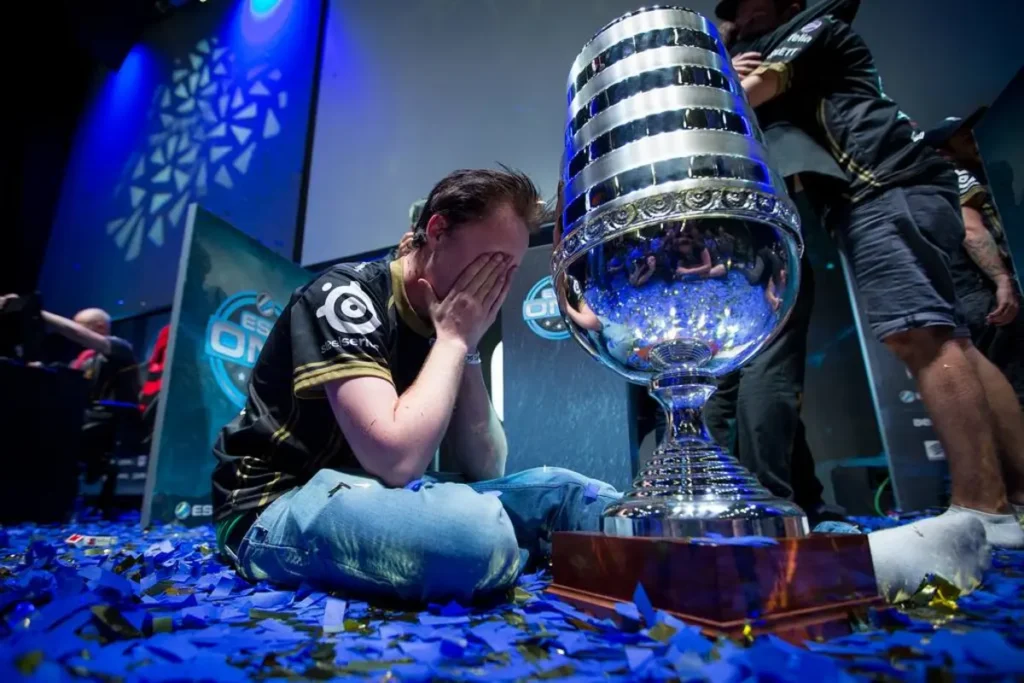
The Counter-Strike 2 (CS2) esports ecosystem is witnessing serious financial strain following Valve’s changes to the Major sticker distribution model.
What was long considered one of the main financial lifeline for professional organizations and esports players has become a massive topic of controversy, with team executives and community figures openly labeling the situation a crisis for tier-two and emerging teams. Here’s everything you need to know.
Counter-Strike’s shift from capsule unboxings to dynamic token pricing
For nearly a decade, Valve distributed Major stickers through randomized capsule unboxings. Fans paid a fixed fee, typically around $1.00 to $2.00, for a capsule that offered a chance at unboxing player autographs, team logos, and rare paper, holo, or gold variants.
While the system attracted some regulatory scrutiny in certain jurisdictions due to its similarity to loot box mechanics, it generated tens of millions of dollars in shared revenue that was distributed evenly among participating teams and players.
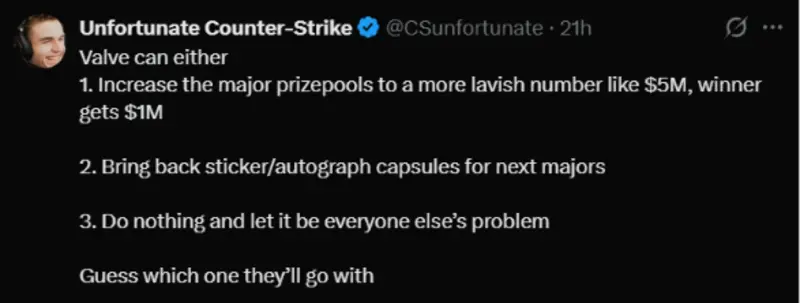
Image credit: X
Ahead of the IEM Cologne Major, Valve introduced a fundamentally redesigned store system aimed at eliminating loot box mechanics and allowing direct purchases. Under the new format, fans purchase tokens (starting at 100 tokens for $0.99 USD) to redeem specific stickers directly.
However, the new shop introduced a dynamic pricing algorithm where prices fluctuate automatically based on demand. When a sticker is purchased heavily, its token price increases while less popular stickers decrease in price.
Thanks to this system, the price of high-demand stickers skyrocketed so high that it became next to impossible for fans to afford. Individual autograph and holo stickers for star players quickly reached prices exceeding $1,500 in token value, which in turn cut trade values.
Severe payout reductions threaten smaller organizations
The dramatic drop in sales volume has severely impacted participating organizations, particularly lower-seeded teams competing in earlier tournament stages. Executive figures across multiple esports organizations reported that sticker revenues fell far short of benchmarks set by previous Majors.
Beyond dynamic pricing, Valve also modified the revenue distribution model. Under the published formula, 50 percent of total Major shop and pass revenue is set aside. Of that 50 percent shared pool:
- 5 percent goes directly to the tournament organizer.
- 45 percent is split among the 32 qualified teams according to a performance and ranking hierarchy, ranging from 2.85% for the 1st place team down to 0.72% for the 32nd place team.
Additionally, Valve has enforced an automatic 50-50 split between organizations and players directly on the Steam platform. In previous years, team contracts dictated how sticker money was split internally, often allowing organizations to retain a larger portion to offset expensive player buyout fees, travel expenses, and operational overhead.
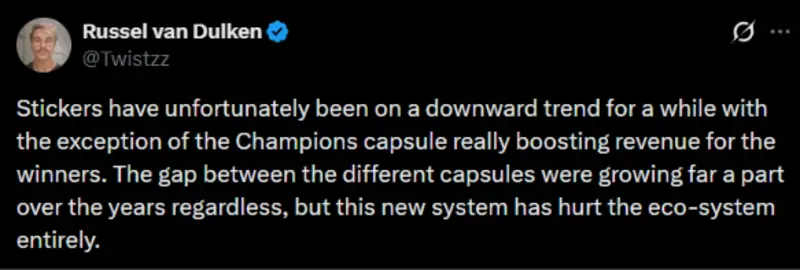
Image credit: X
The sentiment was echoed across social media by prominent figures and professional players. FaZe Clan star Twistzz, alongside community analysts such as Ozzny and CSunfortunate, pointed out how the lack of transparency and sudden structural shift invalidated existing contract negotiations and created friction between players and team management.
What does this change mean in the long term for the Counter-Strike Esports Ecosystem?
While top-tier clubs backed by deep corporate funding or multi-title sponsorships will barely feel any scratch, tier-two and semi-professional teams who rely heavily on Major qualification payouts to justify their operational budgets.
Without the safety net of substantial sticker revenue, organizations are forced to rethink player transfer spending and roster expansions. Industry experts warn that if Valve maintains the current dynamic pricing and revenue-sharing framework for future Majors, the wealth gap between top-tier organizations and the rest of the scene will widen significantly, potentially driving smaller organizations out of Counter-Strike for good.
Featured image credit: Valve





Related Articles
All CS2 News CS2
CS2 CS2
CS2 CS2
CS2 CS2
CS2 CS2
CS2 CS2
CS2 CS2
CS2
 CS2
CS2 CS2
CS2No comments yet






 Spain. LaLiga. EA FC 25. (2x4 min)


 Italy. Seria A. EA FC 25. (2x4 min)


 World Cup. EA FC 25. (2x4 min)


 Champions League. EA FC 25 (2x4 min)


 England. Premier League. EA FC 25. (2x4 min)



Leave a Comment
Join our community or access your account to post a comment.