


Is Dota 2 dying in 2026?


Few games spark as much ‘healthy debate’ as Dota 2, especially when it comes to its longevity. People just can’t wait to let out the cry of “Dead Game!” or ask is Dota 2 dying anytime player counts fluctuate or support wanes. But with player numbers fluctuating, fewer headlines than in its peak years, and new competitive games grabbing attention, it could actually be quite reasonable to wonder whether Dota 2 is losing steam (no pun intended).
Anytime there are longer queue times, fewer updates, and a ‘changing’ (although not shrinking) esports scene, it naturally fuels the question many fans are asking. But “dying” is a strong word, and the reality is more nuanced than a simple yes or no. Dota 2 still boasts a dedicated player base, massive international tournaments, and a constantly evolving meta that keeps veterans engaged. To understand where the game truly stands today, you need to look at the numbers, the community, and Valve’s ongoing support.
The player count paradox
One of the strongest arguments that Dota 2 may be dying comes from its declining player numbers. Compared to its peak years in the mid-2010s, the game has seen a noticeable drop in average and peak concurrent players on Steam. But as recently as 2026, Dota 2 had a huge surge in players, marking a nine-year high. And considering Steam has reached 42 million users, it’s hard to argue that the second most-played game on the platform is dead.
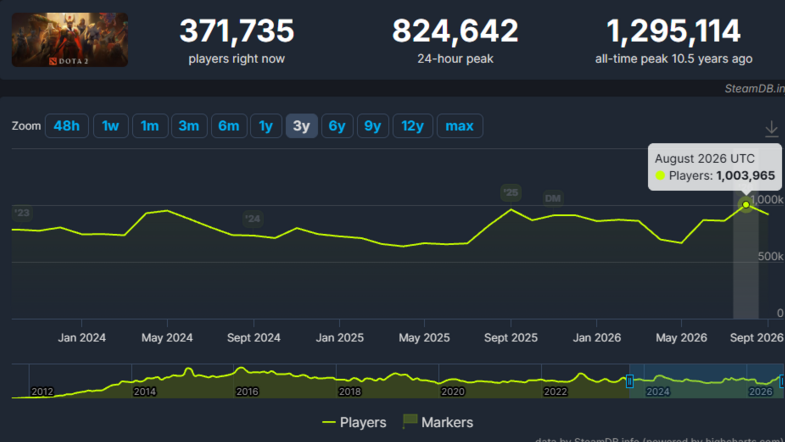
Image Credit: SteamDB
Is Dota 2 dead?
Despite (potentially) declining player numbers, Dota 2 remains far from dead. The game still maintains a large, dedicated core community that plays daily, keeping matchmaking active across most regions. Compared to many online games, Dota 2’s player base is still massive, with an average of over 824,642 daily at the time of writing, and its complexity and depth continue to reward long-term engagement rather than quick, casual play.
Dota 2’s esports scene also signals strong signs of life with a packed schedule of upcoming Dota 2 tournaments. Events like The International continue to draw global audiences, and Valve’s ongoing updates, balance patches, and seasonal content show long-term support rather than abandonment. While the game may no longer dominate gaming headlines, its sustained community, competitive relevance, and active development suggest Dota 2 has evolved into a mature, enduring title rather than a dying one.
If we analyze the peak viewers during big events, we can see that the numbers stood out in August of 2026, when we had the chance to watch The International 2026. In fact, this became the third-most-watched Dota 2 tournament ever, with around 1.79M peak viewers. This made TI15 the most popular International in the last 5 years, something that many people did not expect. With that said, TI15 was not the most famous tournament of the series because this honor goes to The International 2021.
Based on the stats, TI10 had a peak viewership of 2.74 M and the main reason for it was that it was the first big Dota 2 event after the global pandemic. Before that, The International 2019 held the record with around 1.96 M viewers. This was the competition where OG lifted the Aegis for the second consecutive time.
Image Credit: Valve
The state of the game in 2026
The question of whether Dota 2 is dying continues to circulate within the gaming community, driven by changing player habits and shifting industry trends. Critics argue that while the game remains playable and supported, several interconnected factors point toward a gradual decline rather than long-term growth. These concerns often focus on accessibility, competition, and player perception.
- Limited New Player Growth: Dota 2’s steep learning curve remains a major barrier for newcomers. Without major improvements to tutorials or onboarding systems, new players can feel overwhelmed and leave early, slowing overall growth.
- Rising Competition: Rival titles like League of Legends and newer live-service games compete aggressively for attention through frequent content drops and marketing, pulling potential players away from Dota 2.
- Community Frustration: Some players complain about Valve’s limited communication, ‘Valve Time’ for update, the Battle Pass changes, and perceived lack of direction, fueling concerns about the game’s future.
At the same time, the stats do not like – Dota 2 has more average players per 24 hours than it did a few months ago. There is a big difference between having a high average viewership and peak viewership, because the latter usually occurs during a big tournament. The average player base is, in our opinion, the more accurate metric to use when deciding if a game is active because not all of the people who tune in during the peak viewership are regular players. In both cases, Dota 2 is looking better than it did at the beginning of 2026.
More on Dota 2
- Curious about jumping in? Our guide on where and how to download Dota 2 walks you through everything you need to get the game up and running.
- Explore Dota 2’s competitive legacy by checking out our complete list of The International winners and see which teams have claimed some of the biggest prizes in esports history.
Reasons to believe Dota 2 is in decline
Much of the belief that Dota 2 is dying comes directly from community-driven discussions, especially on platforms like Reddit, YouTube, and Steam forums. Players frequently compare the game’s current state to its peak years, when player counts were higher (although not by much) updates felt more frequent, and Dota 2 dominated esports headlines. In fact, there was a recent interview with Pure that surfaced on Reddit, where it became clear that he believes Dota 2 is slowly dying. Interestingly, most comments agreed that the game’s esports site may be in decline, but that does not mean the game itself is dying.
When viewed against that historical high point, it’s easier to understand this point of view. But it’s often not accurate. While the news cycle often forgets about Dota 2, it’s just because its update schedule (only a dozen or so patches a year and maybe one or two major updates) doesn’t feed into the model of live-service saturation.
It also doesn’t help that the most vocal players are often the ones with the biggest gripes. They highlight frustrations around matchmaking quality, balance changes, content gaps, and communication from Valve. When it’s pro players making these criticisms, it can seem like the entire community is against the game. But these discussions are only amplified by the platforms that work off engagement, making dissatisfaction feel more widespread than it may actually be.
Additionally, changes to The International’s prize pool have fueled concern about the long-term health of Dota 2’s esports scene, despite there being more prize pool money across the entirety of the esports scene than ever before.
Image Credit: Valve
Editor’s Take
The debate over whether Dota 2 is dying has gone on for far too long, but the truth is that people who believe the game is in a decline are wrong. The stats are clear – the peak in players for the last 24 hours following The International 2026 is higher than before. In fact, Dota 2 gained 16.5% more players in August 2026 alone, the second-highest increase of 2026 after the massive 30.2% increase in June this year.
Our personal experience in the last couple of months playing has been mostly positive. Yes, you will often have to sit in a queue for up to 10 minutes if you are only queuing as a carry, but that’s the only time when it happens. The matchmaking process is working well across all skill brackets (our team competes in various MMR groups), so there are no issues in this department.
Despite some of the criticism from the community, the Dota 2 professional scene is also doing well. Yes, TI15 did not have the massive prize pool it was once known for, but in terms of tournaments, Dota 2 has a lot to offer. The only downside is that some organizations, such as Team Falcons, decided to withdraw from the game. We really hope to see new ones in the next couple of months.
What we think could kill Dota 2
While Dota 2 is far from dead, certain hypotheticals could threaten its longevity. A major server migration, the loss of Valve’s development support, or a dramatic shift in player interest to new MOBAs could severely impact the game. Additionally, a collapse of its competitive scene or significant technical issues, like persistent bugs or matchmaking failures, might push even loyal players away. In fact, the recent hardware cost issues could affect Dota 2.
Competition from other games
Dota 2 faces strong competition from both other popular MOBA games and non-MOBA games. Titles like League of Legends and Valve’s own Deadlock attract players with frequent updates and accessible gameplay, while games like CS2 or Fortnite pull attention from the broader esports audience. This competition divides player time and engagement, making it harder for Dota 2 to grow its community, even as it retains a dedicated core of fans.
Valve’s interest waning
Valve’s focus appears to be shifting toward newer projects like Deadlock, raising questions about Dota 2’s future. Their flat, decentralized corporate structure means projects succeed largely based on internal developer interest, not external pressure. Without consistent attention from developers, Dota 2 risks slower updates and innovation, leaving it vulnerable to decline despite its loyal player base.
Don’t bet on Dota 2’s demise just yet
The stats are clear – Dota 2 isn’t going anywhere anytime soon. Between its loyal community, regular updates from Valve, and a still-thriving esports scene, the game is very much alive. It might not grab headlines as it used to (at least not after TI), but Dota 2 has proven it’s here to stay, and players will be enjoying it for years to come. The numbers don’t lie – the game has more players than it did before and the numbers remain high, at least for now. In our opinion, Valve will have to step up its game and offer new updates more frequently if it wants to keep casual players interested.
Stick with Esportsbetting.com for more Dota 2 news, guides, info, and more.
Featured Image: Valve



Related Articles
All Dota 2 News Dota 2
 Dota 2
 Dota 2
 Dota 2
 Dota 2
 Dota 2
 Dota 2
 Dota 2
 Dota 2
 Dota 2
No comments yet




 Germany. Bundesliga. EA FC 25. (2x4 min)


 England. Premier League. EA FC 25. (2x4 min)


 Brasileirao Serie A. EA FC 25. (2x4 min)


 Italy. Seria A. EA FC 25. (2x4 min)


 World Cup. EA FC 25. (2x4 min)






Leave a Comment
Join our community or access your account to post a comment.